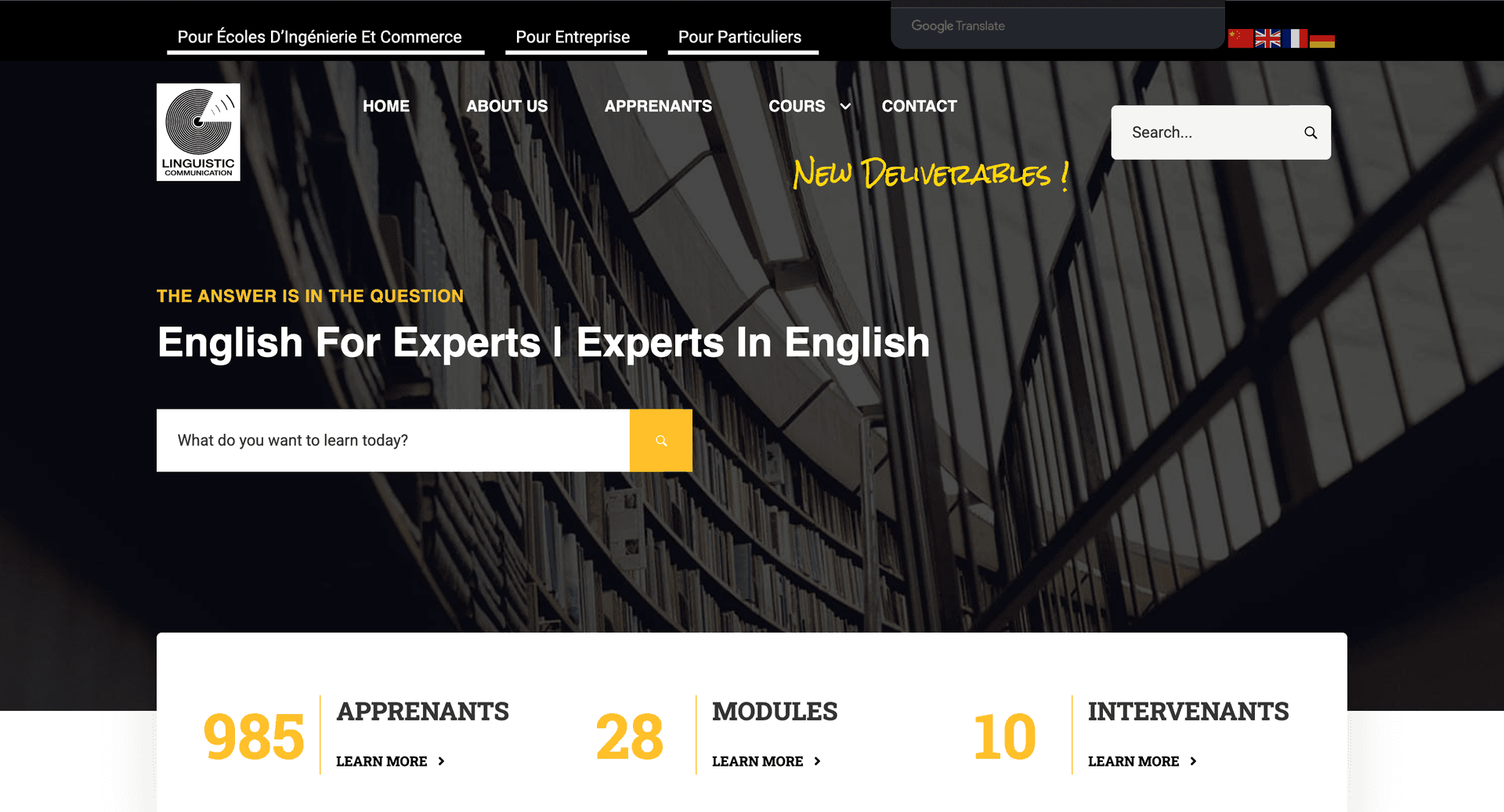
- ProblemUnified three business lines into a multilingual LMS + commerce stack with AI-authored curricula, automated billing, and instant enrollment.
- RoleSolo full-stack consultant (product, platform, ops)
- Timeframe11-week build + pilot launch
- StackWordPress • LearnPress • WooCommerce • Elementor Pro
- FocusWordPress • LearnPress • WooCommerce
- ImpactCourse build time: 4h → 18 min
Problem
Unified three business lines into a multilingual LMS + commerce stack with AI-authored curricula, automated billing, and instant enrollment.
Context
S — Linguistic Communication teaches corporate and academic English across Parisian engineering schools. The team juggled 150+ programs spread over spreadsheets, disconnected landing pages, and manual invoicing. Stakeholders needed a unified LMS that non-technical staff could update, with automated payments and GDPR-grade governance. T — I was engaged to architect an AI-assisted WordPress platform that merged course authoring, commerce, localization, and analytics into one opinionated system without increasing operating cost.
WordPress LMS + WooCommerce for multilingual EdTech delivery
Unified the LMS, commerce, and localization stack so non-technical staff can publish without engineering.
WPML keeps EN/FR content aligned while avoiding duplicate-content SEO debt.
AI-assisted course authoring with GDPR-ready operations
AI templates accelerate course creation while audit trails and retention rules enforce governance.
Performance budgets and structured data improved discovery for professional English courses.
Architecture
- Modeled the entire offering inside LearnPress + WooCommerce with opinionated taxonomies (level, sector, credential) so staff could drag-and-drop programs without editing PHP.
- Built an AI-assisted authoring pipeline: GPT-generated XML templates populate lessons/quizzes, validated through custom WP CLI scripts before import.
- Automated payments + enrollment with WooCommerce hooks — every paid order auto-enrolls the learner, triggers n8n confirmations, and syncs to accounting.
- Applied privacy-by-design: tokenized payments, consent banners, data-retention cron jobs, and WP Activity Log for audit trails.
- Implemented WPML-powered localization with shared components; translators update strings once and propagate to Elementor + LearnPress instances.
- Instrumented performance guardrails (Seraphinite Accelerator, image CDN, script deferral) and set Lighthouse budgets in CI.
- Gave staff a documented design system: Elementor containers, typography tokens, and reusable CTA blocks tested for accessibility (WCAG 2.1 AA).
- Deployed hardened Hostinger stack with daily encrypted backups, staging sync, and application-level WAF.
- Created analytics cockpit via Google Site Kit + Plausible, surfacing enrollment funnels, cart drop-offs, and cohort engagement per program.
Security / Threat Model
- Fragmented plugin ecosystem meant every release risked regressions or plugin conflicts.
- Manual course creation created inconsistent metadata, hampering SEO and reporting.
- Payment flows had to support Stripe, PayPal, and offline transfers while staying PCI/GDPR compliant.
- Bilingual UX (FR/EN) needed to avoid duplicate content debt.
- Performance budgets demanded <2s load time despite heavy LMS features.
Tradeoffs & Lessons
Enterprise WordPress can operate like a SaaS product if you treat infrastructure, content modeling, and operations as one roadmap. The winning move was pairing no-code flexibility (Elementor) with governed patterns (AI templates, design tokens) so creativity never violated compliance or accessibility.
Results
Content teams now publish full multi-section courses in under 20 minutes, replacing copy/paste workflows that took half a day. Automated billing removed 100% of manual invoicing errors, while page speed and structured data lifted SEO ranks for 'cours d’anglais professionnel' into Google’s top 3 locally. Admin workload dropped 60%, and the business onboarded two new enterprise accounts within the first month because curriculum proposals could be prototyped live during sales calls.
Stack
FAQ
Why choose WordPress for this LMS?
It gave admins full content control while still supporting automation, payments, and compliance.
How was GDPR handled?
Consent, retention, audit logging, and tokenized payments were baked into the workflow.
What changed after launch?
Course build time dropped dramatically and admin overhead fell while SEO rankings improved.