LLM Council (Local, Distributed)
Local-first multi-LLM consensus system using Ollama: parallel answers → anonymized peer review → chairman synthesis.
Teaser demo
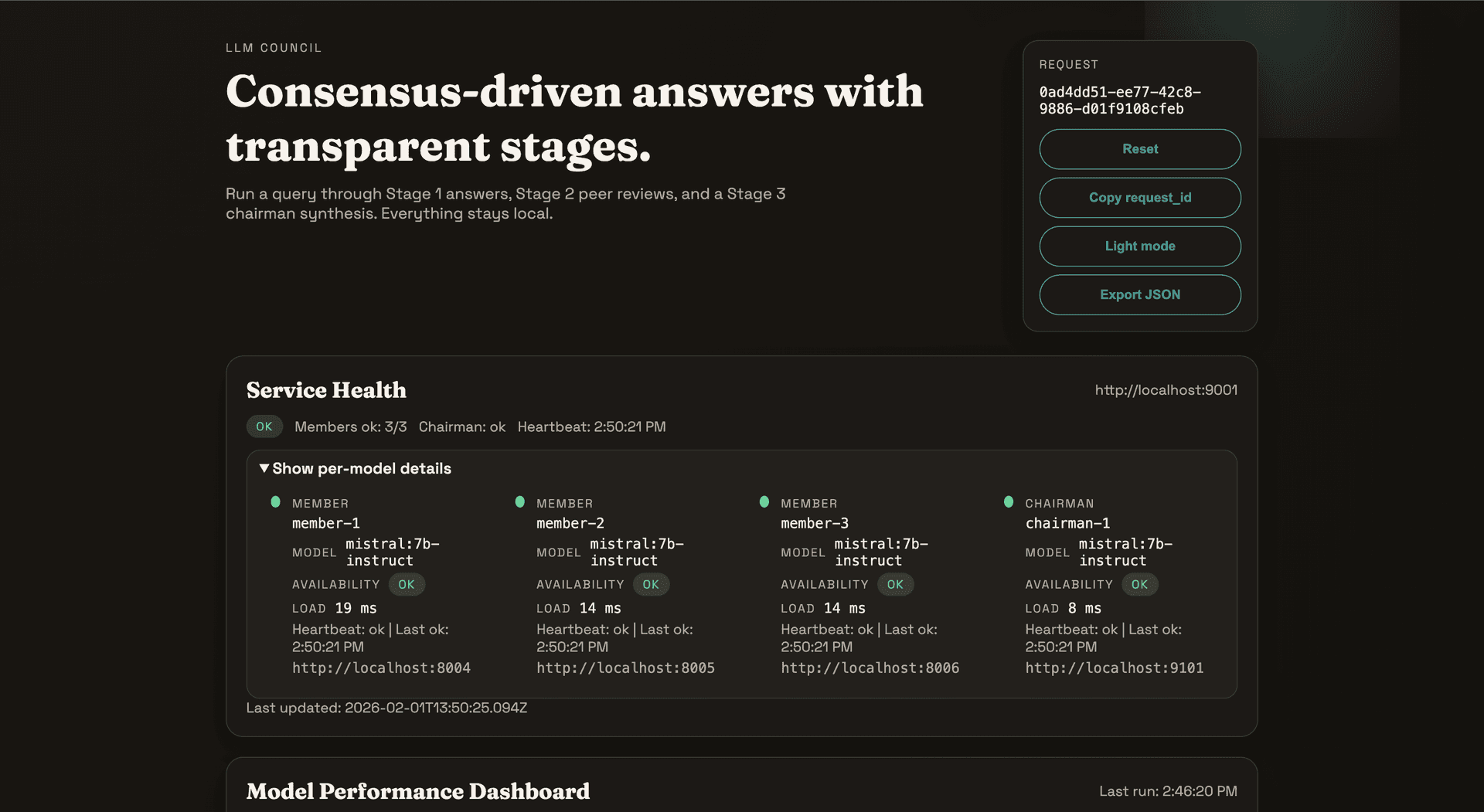
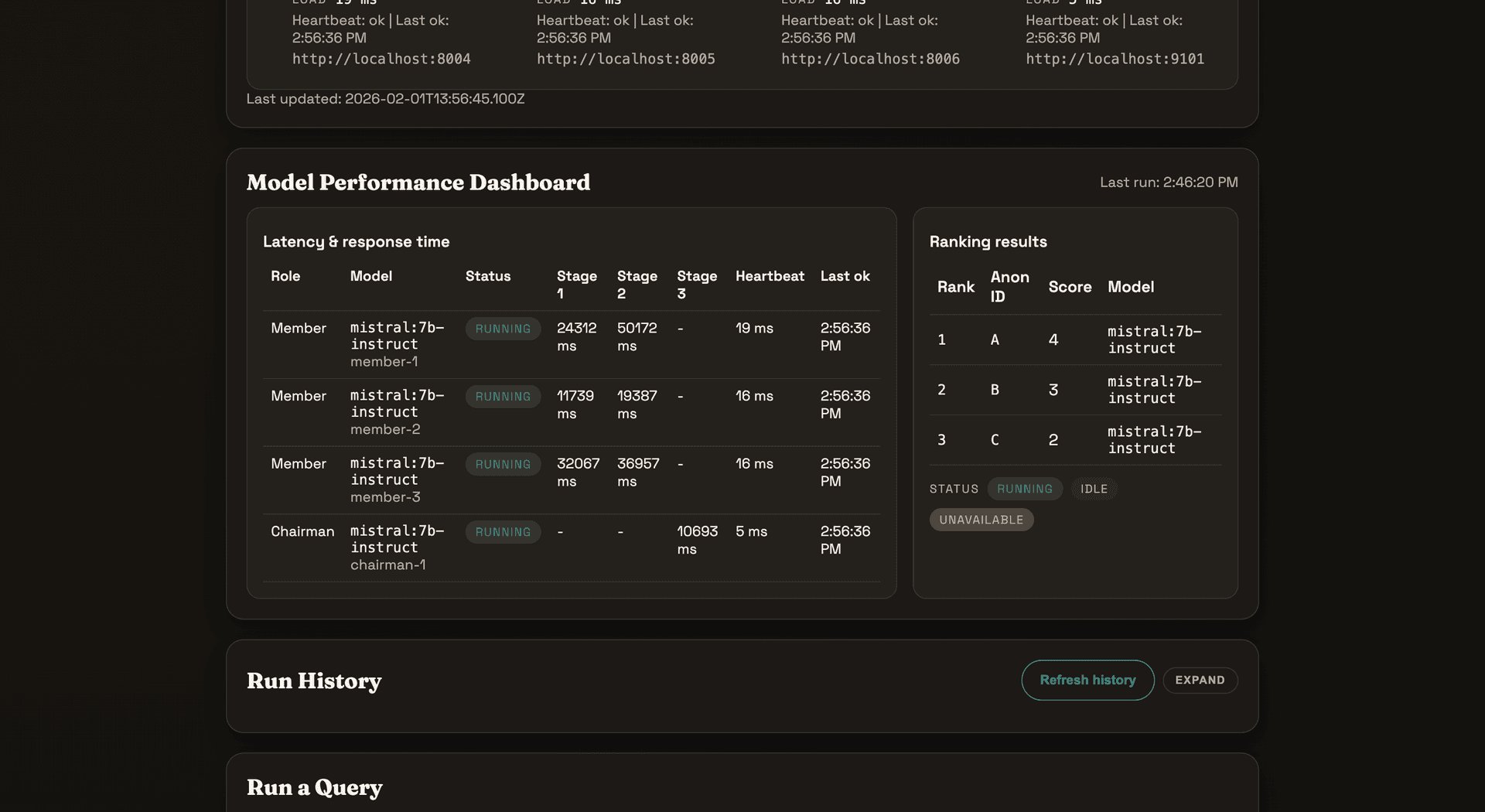
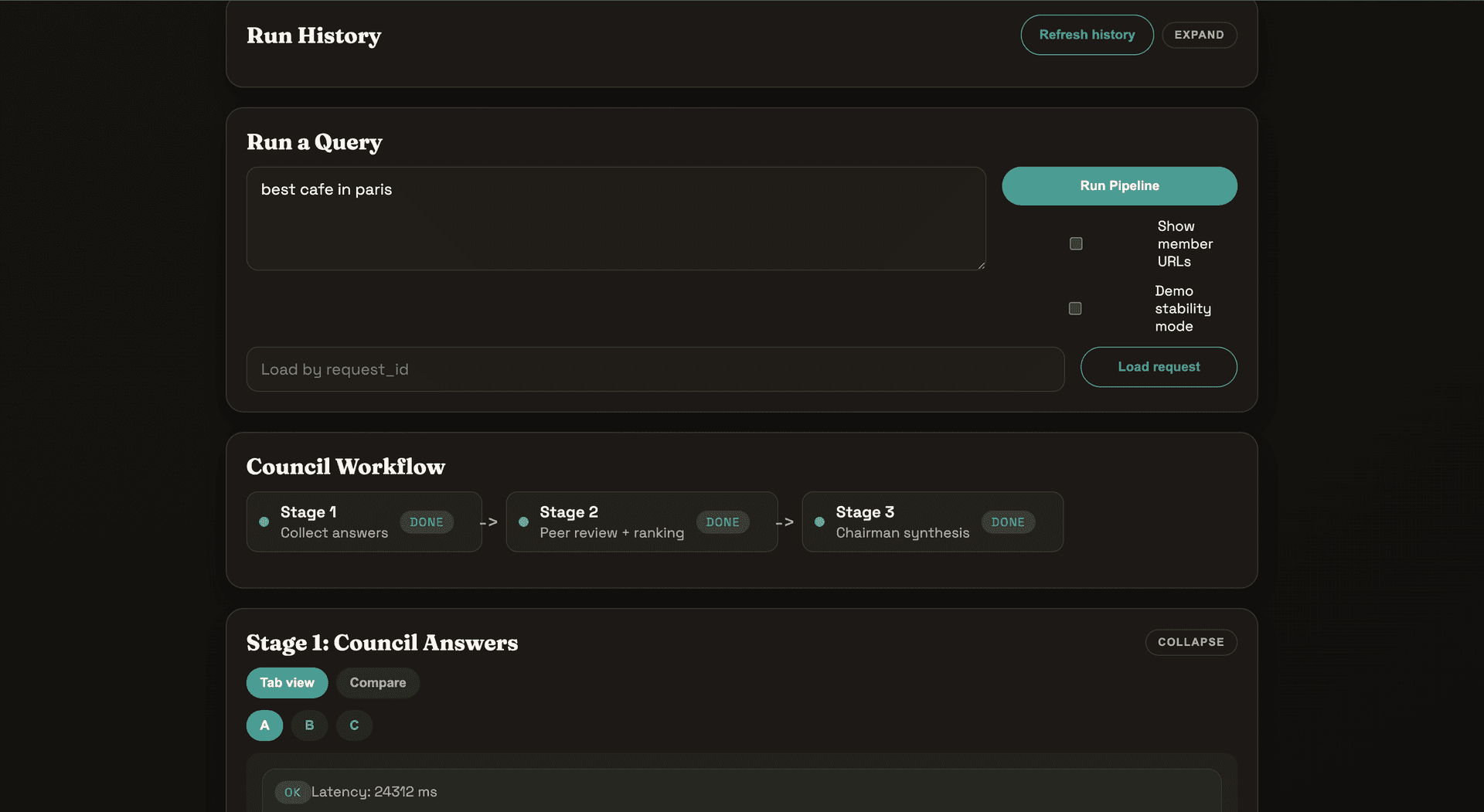
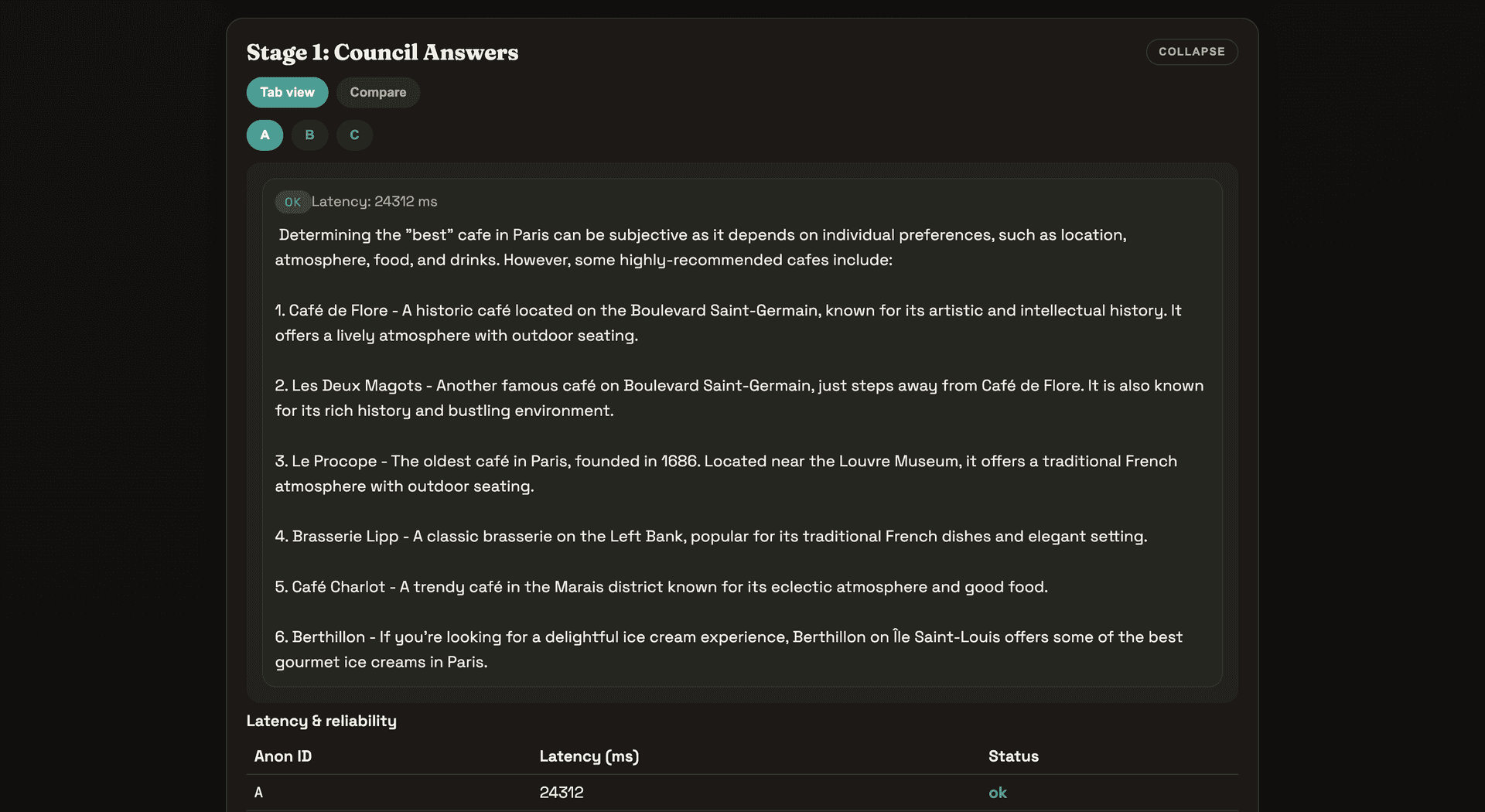
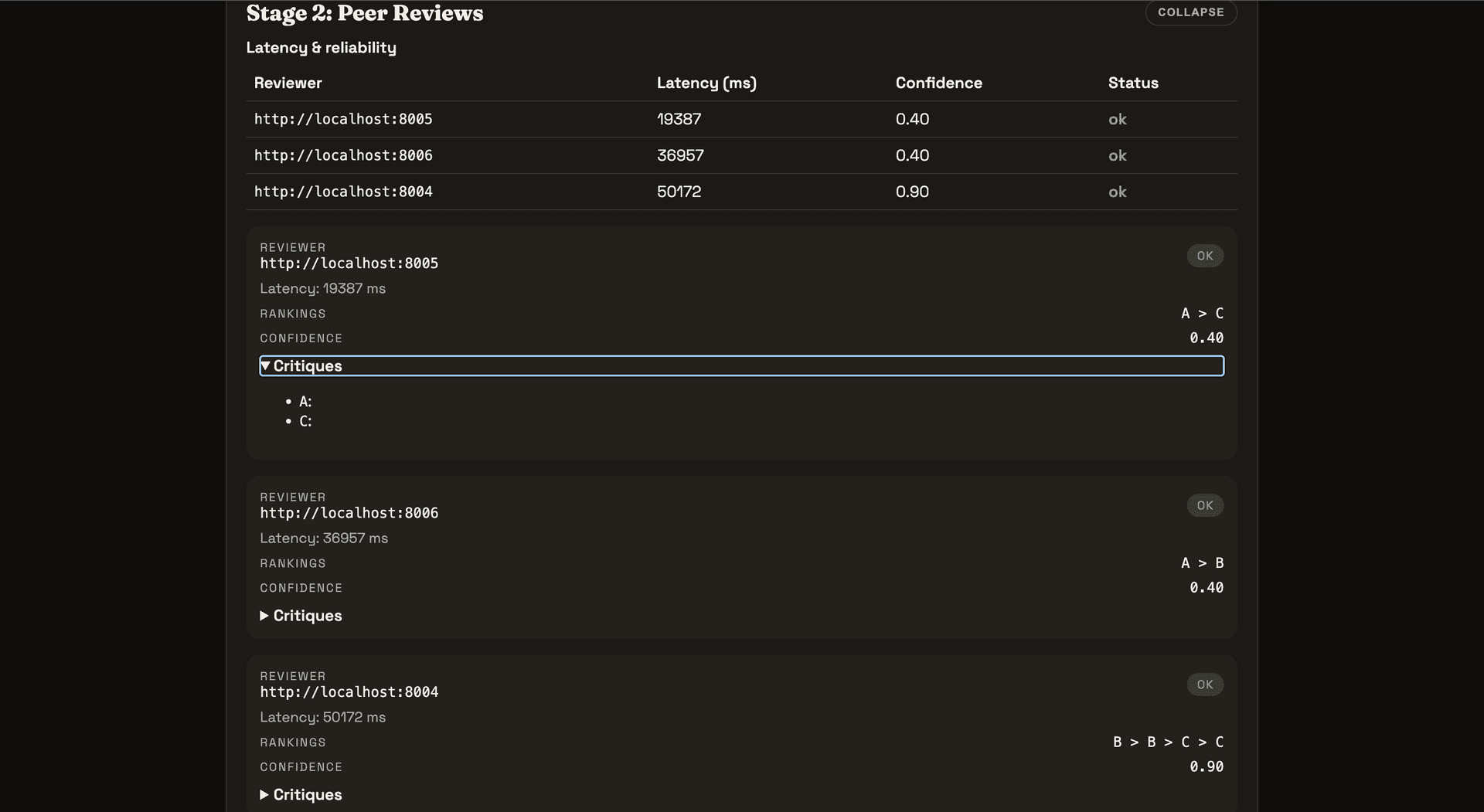
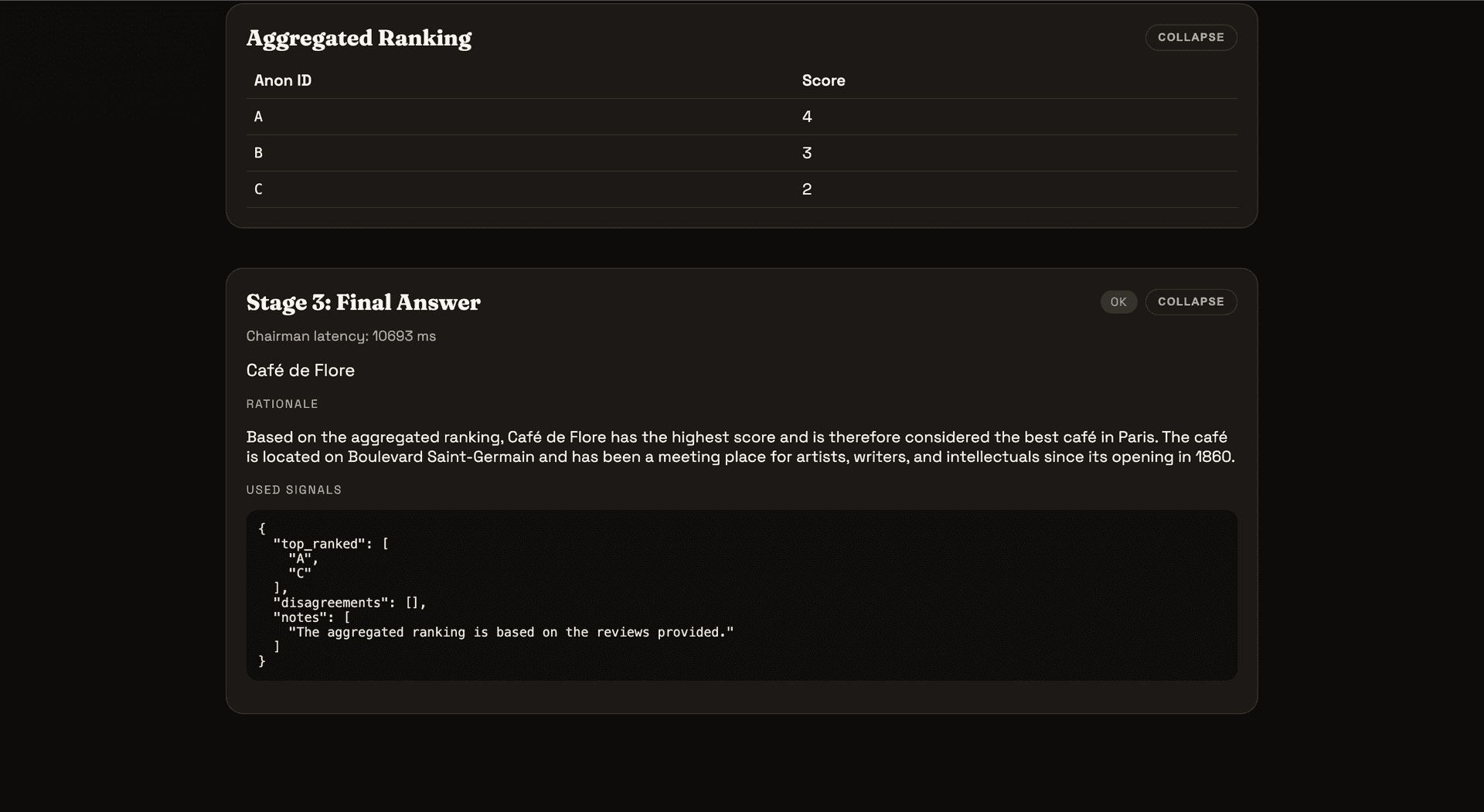
What you’re seeing in 30 seconds: Stage 1 answers, Stage 2 anonymized reviews, Stage 3 synthesis, health + latency.
Problem
Single-model answers can be brittle, biased, or inconsistent. Teams struggle to compare models in a repeatable way, and it’s hard to explain why a final answer was chosen.
Local-first matters: sensitive data stays on the machine, inference works offline, costs stay predictable, and you avoid vendor lock-in.
Solution overview
LLM Council separates roles into independent services: members generate answers, the orchestrator coordinates and anonymizes, the chairman synthesizes, and the UI visualizes each stage.
The orchestrator does not call LLMs directly; it only coordinates requests and aggregates responses from member services.
Architecture
Architecture at a glance — A client UI submits a prompt and policy to the orchestrator. The orchestrator fans out to Ollama peers, anonymizes answers, collects reviews, and passes a ranked signal to the chairman service for a final JSON response. Health/heartbeat metrics and run history persist locally.
- UI: 5173 • Orchestrator API: 9000 • Chairman: 9100
- Member services: 8001–8003 • Ollama: 11434
- Traffic is local only; no external inference calls are made.
Pipeline walkthrough (Stages 1–3)
- Input: prompt + policy from the UI.
- Action: member services call local Ollama models to produce answers.
- Output: N candidate responses with timing metadata.
- Failure tolerance: missing members are skipped; the run still proceeds.
- Input: Stage 1 answers mapped to A/B/C IDs.
- Action: members review anonymized peers and score them (prevents identity bias).
- Output: rankings + critiques with no identity leakage.
- Failure tolerance: requires at least two answers for meaningful ranking.
- Input: top-ranked answers + reviews.
- Action: chairman produces the final response with strict JSON schema.
- Output: single synthesized answer + explanation metadata.
- Failure tolerance: if reviews are incomplete, synthesis still runs on available signals.
Engineering decisions
- Strict JSON schemas (Zod) at every boundary to reject malformed outputs.
- Borda-style aggregation to convert peer rankings into a stable ordering.
- Heartbeat monitoring and aggregated /health for quick node visibility.
- SQLite persistence with WAL for reproducible demos and fast local writes.
- Partial failure tolerance: stage 2 needs >=2 answers; stage 1 can run with fewer peers.
Reproducibility
npm install
npm --prefix orchestrator install
npm --prefix chairman install
npm --prefix ui install

cp .env.example .env
cp orchestrator/.env.example orchestrator/.env
cp chairman/.env.example chairman/.env
cp ui/.env.example ui/.env

./scripts/run_all_local.sh
open http://localhost:5173
Tip: click Run Pipeline, then open the Stage 1–3 tabs.
Security & privacy
- Local-only inference via Ollama; no cloud model calls or external data egress.
- Run history is stored in SQLite and can be disabled via environment settings for sensitive demos.
- No auth or rate limiting by default (appropriate for local demos; add gateway controls for shared LAN use).
Limitations & roadmap
- No auth or rate limiting by default (demo scope).
- No distributed persistence; all state is local.
- Output quality depends on local models and hardware.
- Retry/backoff policies for unstable local models.
- Auth + role-based access for shared LAN demos.
- Consolidated inference client to standardize model config.
- Expanded test coverage for stage transitions and schema failures.
- Optional OpenTelemetry tracing for multi-node debugging.
What this demonstrates
| Capability | Evidence in project | Where to look |
|---|---|---|
| Distributed orchestration | Stage coordination + fan-out | orchestrator/src/server.ts |
| Strict contracts | Zod schemas + JSON validation | orchestrator/src/contracts/* |
| Observability | Heartbeat + /health aggregation | orchestrator/src/health.ts |
| UI visualization | Stage views + run history | ui/ |